Seven families find success with a community vegetable garden
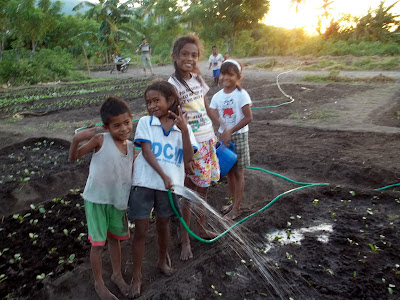
Fransiska (with thumbs up), Katharina, Bibiana, Kartini and Ester Ngole, five of the seven families from Wailiti village, Indonesia in their cabbage vegetable garden. Delighted with their new home enterprise
Friendly visit to Maumere
Toby and Amber Beresford and Jalu make a friendly visit to the city of Maumere, Sikka District, to see at first hand the development of MicroAid Projects that have been funded.
Family vegetable garden training
To increase family incomes further, the group of mothers will now expand the area of the vegetable garden and plant mustard. Money from harvest of cabbage will be used to purchase mustard seeds and will be planted near their existing garden.
September 01, 2012
Moving Web Address
June 08, 2012
Life becomes easier through the family vegetable garden
We live and manage the family vegetable garden In Wailiti village, Sikka regency, East Nusa Tenggara, Indonesia. It is currently the end of dry season and will coming to rainy season soon so we need a lot of water for watering the plants. We have also just finished planting spinach seeds.
Praise God, from the harvest result of cabbage and broccoli we grew on the same land, and with additional funding we get from MicroAid, then we can buy a new water pump. This allows us to water our plants. We are all happy because it is easier to water the plants using a water hose, no need to use a bucket that we had to take water from far away.
Again and again, we are grateful for the grace of God. All has become much easier now. Easy to water the plants because we use a water hose, easy to care for the garden because the whole family helped and easy sell our harvest because buyers come directly to our gardens to buy the crop.
Fransiska and four other housewives with the help of their children are currently busy taking care of vegetable gardens run by the family. In January 2011, they only manage a vegetable garden area of 100 m2 which planted only cabbages. Because so many were interested in the results of the vegetable garden, now they have added to their garden area up to 400 m2 with kale, collards and broccoli. Thank you MicroAid and the Toby Beresford family, who came to visit us last year.
Read the full project report here
If you want to buy our crops, please visit to our village...
Fransiska and family group,
Wailiti village, Sikka regency, East Nusa Tenggara, Indonesia
May 02, 2012
New Look Websites at MicroAid
MicroAid Projects
A place to fund poor families directly so they can learn a new home enterprise skill. Helping people help themselves.
MicroAid Library
Our MicroAid library shares experience in video, audio, text and reports on Best Management Practices (BMPs) for interesting products for low income families. Using the same BMPs for their home enterprise, families can join together in clusters with other micro-producers that provide the quality and quantity needed by the market.
MicroAid Connections
Using Linked In and other social networks, we connect the private sector to the bottom of the pyramid in shared value supply chains for sustainable livelihoods products. Connecting directly offers the traceability and corporate social responsibility (CSR) now demanded by new consumers.
Informed People + Quality Product + Market Connection = Sustainable Livelihoods = Poverty Eradication
Warm regards,
MicroAid Projects Team
September 27, 2011
Selling embroidery crafts at the Pillayarpatti Temple
My name is Jamuna from Pillayarpatti village, Tamil Nadu, India. Initially I was a housewife. At that time, the economic situation of my family was in big trouble. To increase my family income, I was working in some embroidery shops in my village and got a little income.
![]() |
Jamuna sells her embroidery crafts at the Pillayarpatti temple |
Now 4 months after the training, I have developed my own craft products and have started selling them at my local market. This is a much better opportunity for me to increase my income. Now I earn more per day than I used to earn working as a labourer at the embroidery factory. Per day on average I can get US $1.63 - $2.04 from the sale of my crafts. Sometimes just getting $1.02 when not much visitor and could reach $5 if in holiday and many visitors who come to the temple. Now I sell my embroidery crafts at the famous temple in Pillayarpatti village where many people come to pray. I would like to say a big thank you to Ford Trust and MicroAid for my skills training.
Now I have a good future.
Warm regards,
Jamuna
September 16, 2011
Skilled mother, happy family
![]() |
| Fransiska (right rear) and her husband Thomas (right front) and their children. Fransiska can now educate her children by selling vegetables from the cabbage garden behind her house |
It is the obligation of every parent to provide education for their children. But what if the family is poor and whose life and livelihood have been hit by illness and deprived of the resources, many of us take for granted? Empowering the family is one of the key strategies MicroAid projects uses to eradicate poverty. Empowered families can pay for food and education for their children on their own.
The photo above is Thomas and family with four children live in Waility village, East Nusa Tenggara, Indonesia.
Since 1986 Thomas was paralyzed, his legs cannot be used for walking. Thomas's day-to-day job before he became disabled was as a fisherman. Many men in Waility village are fishermen. They look for fish in the sea and sell their catch in local markets. As a result of the illness that disabled him, Thomas can no longer work as fisherman.
There is no a worker insurance or social services in Waility village. So the livelihood to meet the needs of his family life stopped abruptly and there was no help around for a family of six. There was not enough food on the table and the children could not go to school.
Until now, Thomas does not know what causes his paralysis. Medical services are also scarce in this part of the world. One day when he woke up in the morning, he could not move his legs. His family and friends brought Thomas to the doctors and local hospital but until now the disease is not curable. In 1994, Thomas was married to Fransiska. From their marriage, Thomas has been blessed with 5 children. But one of his children died as an infant, so now there are 4 children who they are responsible for.
To support his family, Thomas worked as farm labourer in his neighbour's vegetable garden. He carried out all his work activities crawling, because his legs could not be used. Fransiska, his wife, helped to meet the needs of their family by working as a housemaid cleaning, washing public facilities and any chore to earn money to feed the family.
Through the training for village nurseries that was funded by donors of MicroAid Projects in 2010, Fransiska has become the inspiration for mothers in Waility village to manage a cabbage vegetable garden. In early 2011, Fransiska, Thomas's wife took over her husband's role as the family breadwinner. Fransiska along with 6 other women, neighbours, manage together a vegetable garden that is just at the back of their house. Initially Fransiska was a housewife who filled her time caring for her family, just like most other mothers in the village.
![]() |
| Photo caption: Now the buyers that come to the village and immediately buy up all the vegetables as soon as they are harvested |
Each harvest, Fransiska earns about £43. With this income every month, Fransiska can send their four children to the public schools in her village and buy textbooks. But the necessities of life are not only that. There are still many other things needed to further enhance the welfare of families like Fransiska.
MicroAid Projects with a method of learning business skills as an approach to empower the poor family, invites you all to give a big opportunity for groups of poor families in Indonesia, Pakistan, India, Bangladesh, Kenya and Uganda to learn new skills that can be used to improve the welfare families so that they can educate their children independently and sustainably.
Today, Thomas and four of his children help Fransiska after school in the watering and clearing the family's garden with pride. They are very grateful to MicroAid donors who have given them the opportunity to learn new skills and how to make money from a vegetable garden so that they can find a way to eradicate their poverty themselves.
A little help for a better future for one poor family - MicroAid.
Thank you MicroAid donors
from
Thomas and Fransiska
August 18, 2011
Your Zakat is more than just for eating
![]() |
| A mother was sewing at home to fulfill customer orders |
Jalu Wardhana, Team Leader
May 18, 2011
Friendly visit to Maumere
![]() |
| Amber with a woman who learn to make woven clothes |
- Garden vegetables such as broccoli and mustard seed.
- Using fermented garden fertilizer on their land
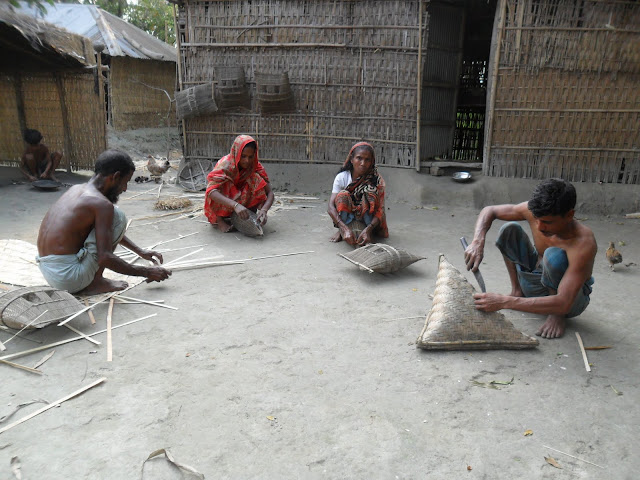
- Making woven clothes with simple tools
- Cashew nut processing
- Introduction to healthy family living
October 14, 2010
MicroAid Projects has opened my eyes
![]() |
Caption: Niba with her sheep and two lambs |
![]() |
Caption: Niba Rani’s family house before renovation |
![]() |
| Caption: A new house for the family which was built by Niba Rani from the result of a MicroAid Project - simply breeding ducks |
If you have enjoyed reading this story, why not pass it on to friend. Maybe Microaid can raise some more money to send to other girls like Niba, who need their eyes opened in one way or another? MicroAid Projects - simple ideas for helping to reduce poverty.
August 06, 2010
From a mini bus driver to a silversmith
My name is Hendrawanto. I am 23 years old. Before the training to learn to make silver jewelry (see micro project PUSP1303), I initially was just a public vehicle’s driver in Cilebut village, West Java, Indonesia and has no fixed income. Sometimes in a day I only earn Rp 10,000 (USD $1) and sometimes losing money because no passenger to pay the rent I pay for the mini bus and fuel.This is certainly not sufficient for the needs of my household and school fees of my children. I decided to find another better livelihood. In January 2010 with two friends, I followed the training activities to make silver jewelry which was funded by MicroAid Projects. My father was pleased that through this training, I became aware that making silver jewelry is not too difficult. After studying for a month with friends and was encouraged by my own father, now I can help my father run the family business making silver jewelry. My father was a silversmith working from home on casual orders.
I now already have two staff who are my friend who trained with me. Now we are working together in family enterprise and my livelihood has improved.
Thanks to Mr. P. Mayer and MicroAid Projects who helped me get a start in life.
Hendrawanto,
Cilebut Village, West java, Indonesia
Read the full report
July 28, 2010
SRI Paddy Harvest Preparation
July 20, 2010
Donate for Women’s Enterprise Activities
In MicroAid Projects, women are given the opportunity to be directly involved in proposing and then carrying out training activities in line with what they really need. Help these low-income women learn simple activities that could be a vital way to supplement their subsistence family incomes.
See the women's enterprise activities
Posted in: microaidJuly 09, 2010
Training for face makeup in Bangladesh
Donate now
Posted in: microaidJune 22, 2010
Introducing new technologies in Kenya
Community Empowerment Programme Sustainable Development (COSDEP) is a non governmental organization working in Kenya. This foundation helps poor families learn new livelihoods skills that can help these women raise income for their families.
A MicroAid micro-project was carried out in May 2010, by introducing a simple new technology to make laundry soap made from potatoes readily available in their village. Besides food, potatoes can be processed into soap. The tomatoes are also numerous in the village which also made jam.
Irene Wangari said “The training has opened our minds on how to utilize our locally produced commodities in a more useful way. We will use this livelihoods knowledge to better our lives”.
Read the full project report
June 21, 2010
Environmentally friendly technology; wards off pests without killing local ecology
With products that are introduced by Tovan, many farmers can cultivate paddy rice crops and can prevent any future plant pests without killing the pest. Yes it’s true, do not kill the pests, ward them off they are part of mother nature’s natural ecology, which we destroy at our peril.
Here's a brief description of how the production cycle works:
Organic liquid fertilizer is used to support the acceptance of nutrient or food for the plant. This is necessaryso that plant nutrient needs are met. Liquid fertilizer is first fermented over 15 days before use. This liquid fertilizer has a high nutrient content making it suitable for many different crops.
The materials used were: old vegetation up to 20%, cow urine10%, crude cow dung 5%, maja fruit, bran 15%, 50% water and 1 kg of sugar.
Vegetable pesticides serve to repel pests from plants, not eradicate the pest. The materials used come from plants that are not favored by these pests and plants easily obtained as: Tuba Leeches Leaves, Sentang leaves, sour soup leaves and other leaves. Before being used crushed and their juice was taken first, then sprayed once a week which is useful for pest prevention (rather than killing pests).
June 03, 2010
Sign Up MicroAid Projects Newslleter

As you know, MicroAid Projects sent the monthly newsletters directly from the editorial desk. If you want to subscribe to receive the newsletter via email each month, please enter your email address on the following link SUBSCRIBE NEWSLETTER
Sincerely,
MicroAid Projects Team
April 13, 2010
Cause of the week

Posted in: microaidApril 09, 2010
What is MicroAid Projects?
MicroAid Projects is a development charity that reaches out to poor families via the internet with simple training in profitable family enterprise.
MicroAid’s mission: Empowering poor families to eradicate poverty from their lives through family enterprise.
MicroAid’s goals: To establish local community facilitation partners in poor areas who can connect low income families to micro aid for family enterprise skills training.
MicroAid’s objectives: To increase incomes of poor families particularly women reached by MicroAid Projects to above $2 per person per day sustainably.
MicroAid’s work: 800 poor families from 7 developing countries such as Indonesia, India, Pakistan, Bangladesh, Uganda, Ghana and Kenya have participated in MicroAid Projects through direct donations family to family across the world.
www.microaid.org
Community Facilitation Partner prepares family enterprise training micro-projects with a group of poor families to publish online. MicroAid Projects donors can choose a micro-project and directly fund online either sharing with others or on their own. Total aid provided for each micro-project is approximately £100. Each micro-project is reported via email directly to each donor including text, photos and sometimes video.
How MicroAid uses your donations and contributions? Your donation will be used to finance home training activities, simple family enterprise materials - not as a business capital, overseas donation transfers and field office activities. MicroAid Projects is an online, UK voluntary organization. There are no UK overheads costs. Registered Charity No 1125206
What do poor families do? Poor families make micro-project proposals to learn new skills that can be used to increase incomes from their family enterprise and work independently. Give them a fishing rod, not a fish, so they will in the future find their own fish.
Posted in: microaidApril 01, 2010
Using family enterprise to eradicate poverty
With only one planet we all need to work together. Global travel, interwoven economies and a fragile environment mean it's no longer a case of live and let live. Now we must help each other for everyone's benefit.
A poor family in Calcutta might raise a chicken whose bird flu causes people to die in the USA. A British business might create pollutants that destroy the fishing of a family in Bangladesh. We are inter dependent.
But those in poverty struggle to help themselves, protect and educate even their own children, let alone help solve our shared problems like bird flu, terrorism and global warming.
This imbalance hurts us all. By eradicating poverty we help create a stronger, more sustainable planet for everyone - wherever they may be.
Posted in: microaidFebruary 03, 2010
MicroAid Blog for Mobile
Mobile Site URL: http://mippin.com/microaidprojectsblog
October 23, 2009
Woman activity project

Please support five young women who want to learn for wall decorative crafts in Indonesia.
Make a donation now
Thanks!
Posted in: microaid