Showing posts with label Article. Show all posts

June 08, 2012

Life becomes easier through the family vegetable garden

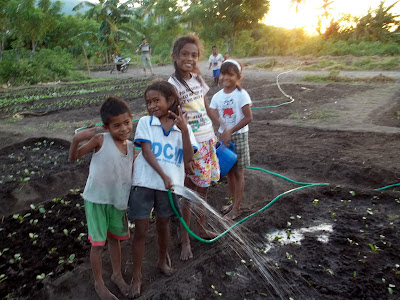
Meta, one of Fransiska’s daughters, is wateringkale seeds using a hose pipe purchased from the results of the vegetableharvest of rural cabbages (collard) and broccoli. All are happy because it iseasier to water the plants using a water hose, no need to use the bucket.

We live and manage the family vegetable garden In Wailiti village, Sikka regency, East Nusa Tenggara, Indonesia. It is currently the end of dry season and will coming to rainy season soon so we need a lot of water for watering the plants. We have also just finished planting spinach seeds.

Praise God, from the harvest result of cabbage and broccoli we grew on the same land, and with additional funding we get from MicroAid, then we can buy a new water pump. This allows us to water our plants. We are all happy because it is easier to water the plants using a water hose, no need to use a bucket that we had to take water from far away.

Again and again, we are grateful for the grace of God. All has become much easier now. Easy to water the plants because we use a water hose, easy to care for the garden because the whole family helped and easy sell our harvest because buyers come directly to our gardens to buy the crop.

Fransiska and four other housewives with the help of their children are currently busy taking care of vegetable gardens run by the family. In January 2011, they only manage a vegetable garden area of 100 m2 which planted only cabbages. Because so many were interested in the results of the vegetable garden, now they have added to their garden area up to 400 m2 with kale, collards and broccoli. Thank you MicroAid and the Toby Beresford family, who came to visit us last year. 
Read the full project report here

If you want to buy our crops, please visit to our village...

Fransiska and family group,
Wailiti village, Sikka regency, East Nusa Tenggara, Indonesia


May 11, 2010

Harvest of fish and rice together

As the proverb in Indonesia; while diving drinking water. This has been practiced by Tovan, MicroAid Projects CFP volunteer and the farmers in Rime Raya Village, , Bener Meriah District, Aceh Province of Indonesia. They grow rice by SRI method (System of Rice Intensification) in their village and use the same land for breeding the Nila fish.

Yes, SRI rice paddy fields are flooded requiring sufficient water (no more and no less). The water is also used by farmers for the cultivation of Nila fish on the same land. Great land uses two for one!

Tovan and the farmers had been trained on micro projects funded by MicroAid donor in January 2010 ago and right now they're waiting for the harvest time in the coming days. The concept of land use for two different products at the same time has never carried out by local farmers. When the program is successful, then this concept will be passed on to farmers in other villages and even beyond the province of Aceh.

See their micro projects on: http://www.microaid.org/?q=content/training-fish-breeding-rice-paddy-fields 

Foot note
Tovan Marhennata is a graduate student who has decided to take his agricultural skills back to the village where he grew up. Tovan wants to become a successful organic entrepreneur and at the same time eradicate poverty for the community of his birth. 

Aceh, and particular the highland areas where Tovan is working, has been racked by conflict for decades.  Tovan is determined to show a peaceful example of how poverty and hardship can overcome without conflict and weapons but by hand hoes and exciting new small holder’s technologies.  These technologies are developed in other areas but now available globally through the power of the Internet.  SRI Rice growing techniques were developed in Madagascar in the late 1990s. 

MicroAid is sponsoring Tovan as Community Facilitation Partner in this challenge.

April 27, 2010

Helping the poor to help themselves

MicroAid's article on About.com: Nonprofit charitable orgs.
Click this to read more detail 

August 26, 2009

How a micro project works?

The main steps involved are:

A poor family (potential beneficiary) recognizes and understands their own needs to help themselves out of poverty.

A micro micro-project idea is formulated micro-project to address this need. Micro-projects are an activity, the budget required; the people involved often a small self help group and the output to be achieved.

This is often only after discussion with facilitators from small local NGOs known as Community Facilitation Partners (CFP).

The CFP perform a poverty assessment of the potential beneficiaries (for example income per family member is less than US$2 per day (a primary UN Millennium Development Goal (MDG) target for poor families). CFPs also validate the integrity, viability and potential of the micro-project.

If the micro-project passes the previous stage, the facilitator assists the potential beneficiaries to describe and cost the micro-project and put it on the MicroAid Projects website using the NGO's micro-computers and Internet links.

A donor sees the micro-project on the MicroAid Projects web site http://www.microaid.org and chooses to sponsor it by making an online donation. From this point on, the donor can track the progress of the transfer of funds, initiation and completion of the micro-project on the MicroAid Projects website.

The funds are transferred to the beneficiaries, who carry out the activities of the micro-project and gain a long term benefit from what they learn.

The beneficiaries write a report on the success of the project, which can be viewed online by the donor.

August 25, 2009

What is a micro project?

A micro-project is a very small project suggested, owned and managed by the beneficiaries (poor families with income less than US$ 2 per day) themselves.

This is in contrast to what we would normally mean by a project which has a project manager with a set of beneficiaries who are not running the project.

Another name for a micro-project is "self help". Something that an individual can do to improve their own lives.

All micro-projects have four stages:

  1. Preparation - analyzing families own personal situations and identifying needs in terms of activities required to improve their standard of living.
  2. Planning - selecting an activity that families can do to meet their needs
  3. Implementation - doing the activity
  4. Review - reporting on the success or problems in the activity in meeting their needs
When you see a micro-project on MicroAid web site, it has already been prepared and planned and is ready for implementation. It will probably need a few extra external resources for the micro-project to happen. This is where online internet donors are needed to provide that little bit of extra help, the catalyst, without which the micro-project does not go ahead.

So, in contrast to a normal project, the major resource in a micro-project is the person who does it. There may be other resources required such as good information, local facilitators and teachers, activity plans, and finance to pay for small items such as transport or trial materials. But these are all secondary to the person themselves who must put in the most effort.

This is why we call our approach "MicroAid" because the required external resources (aid) is small (micro) but the internal resources (the person themselves) is large

July 28, 2009

What makes MicroAid special?


MicroAid's motto is: teach a man to fish, feed him for a lifetime.

MicroAid Projects helps poor people learn new skills that will create income for them and their family.

  • MicroAid promotes self help with short small educational projects that lead to independent businesses (no chance of long term dependency),
  • MicroAid avoids distorting the market by not giving capital goods (no free cows on us)
  • We use very local Community Facilitation Partners who have been in place for years; so we ensure that only truly poor people can access the support
  • MicroAid is a "bottom up" charity; we only do what local people ask;
  • We can reach via the internet into the remotest communities in the world yet still keep track of progress.

We also make things pretty cool for donors:

  • We provide you personalized direct feedback as videos, photos and comments from your chosen micro-project, so you can see what happened with your money;
  • MicroAid lets you choose your own projects so you can follow a specific village or family out of poverty; try doing this in your own family, classroom or friendship group.

Why we need your support?


MicroAid Projects charity worked to help more than 800 low income
families in developing countries last year. An amazing number for such
a small charity.

Because we use the internet, administration staff in Jakarta, Indonesia
and because we don't have our own project offices, MicroAid is very cost efficient.

But like any charity we do need your support to keep us going - it may
be giving us a pat on the back, making a small donation, sharing the
web site with friends, helping with our running costs or even becoming
a volunteer.

What we'd really like is for you to make a monthly donation of £4, £8 or £16 depending on what you can afford.

Please consider becoming a MicroAid donor.

Your funds really will help. You can choose what happens to your
money - it can either go 100% to projects, 100% to running costs or
half and half. That's up to you. What matters is your support.

How every donation helps

Let's say, for example, you gave £16 every month for a year and chose to spend 100% on projects.

Based on 2008 micro-projects that would have meant you could have paid for two projects that helped 10 families
try out a new home enterprise idea directly. This would cover the costs
of making something happen in a poor community somewhere in the world.

What countries my donation could go to?

Your money might go to: Kenya, India, Ghana, Bangladesh, Indonesia, Pakistan, Uganda or Cambodia, the choice is yours.

Who is poor?

A low-income person is defined as someone living on or just below the
poverty line of being able to purchase a 1kg bag of rice per day.

That means you'll be helping people who can't buy drugs when their
babies are ill, can't pay for education when their children grow up and
can't feed themselves when harvests fail.
People on the bottom rung of life.

Poverty is a disease. MicroAid kick starts small family enterprises that are a very important part of the cure.

Join the MicroAid family today and you become part of the solution.

There is a donation form to fill in at the end of this booklet, even if a small donation, please fill it in and give it to us.

It may be a little to you but it means so much to us.

Funds for your micro-project are really sent directly to the village.

The only expenses incurred are in transferring donated funds abroad, which are UK
and Indonesian bank charges of about 10%.

Where possible we fund several projects in one go to reduce the bank charge overhead.

For each project you can see a detailed budget breakdown of how your money is spent.

Why eradicate poverty?


With only one planet we all need to work together. Global travel,
interwoven economies and a fragile environment mean it's no longer a
case of live and let live. Now we must help each other for everyone's
benefit
.

A poor family in Calcutta might raise a chicken whose bird flu
causes people to die in the USA. A British business might create
pollutants that destroy the fishing of a family in Bangladesh. We
are inter dependent.

But those in poverty struggle to help themselves, protect and
educate even their own children, let alone help solve our shared
problems like bird flu, terrorism and global warming.

This imbalance hurts us all.
By eradicating poverty we help create a stronger, more sustainable planet for everyone - wherever they may be.

What is MicroAid Projects Charity?

MicroAid Projects Charity is a development charity that helps poor families to eradicate poverty with their own small home enterprises.

MicroAid Projects pays for "learning activities" - simple education and hands-on training for poor families to try a new home business idea without risk of failure.

If the idea turns out to work well (like Hasyim's woven handbags) we then let them get on with it, or if they need more capital, we introduce them to a local bank to get a microcredit loan.

If the idea doesn't work (like Hasyim's original cow skin crisps..) we fund them to learn about a different business idea.

 
Design by Wordpress Theme | Bloggerized by Free Blogger Templates | coupon codes